
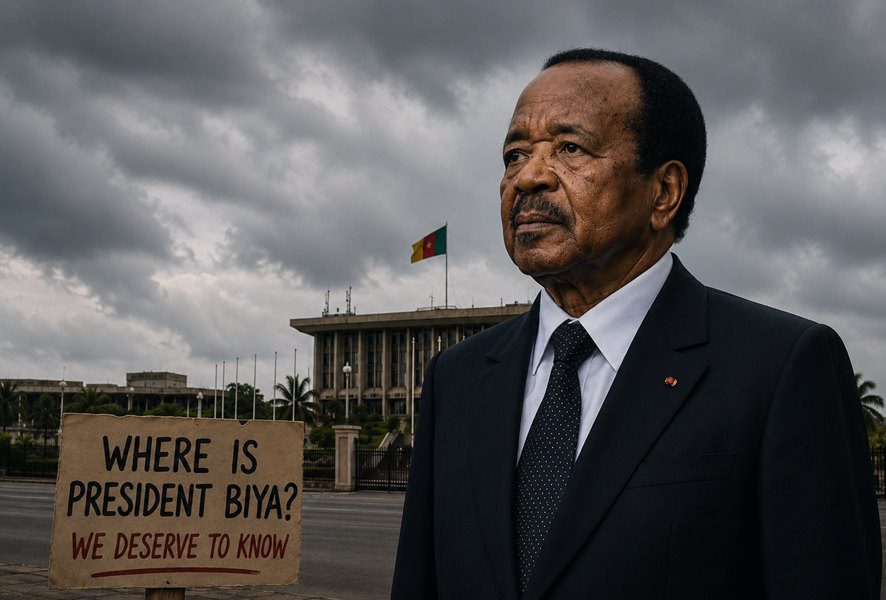
Paul Biya left Cameroon on June 7 for what officials called a brief private stay in Switzerland. Two months on, his absence has become a test of Cameroon’s institutions rather than a question about one man’s whereabouts.
By Oman Belamy, UZURI Press
YAOUNDÉ, Cameroon — For more than two months, the president of Cameroon has been outside the country.
Paul Biya, 93, left Cameroon on June 7 for Switzerland with his wife, Chantal Biya. He was last seen in public on May 20, during National Day activities in Yaoundé; his destination was disclosed only afterward, by Communication Minister René Emmanuel Sadi. He has ruled Cameroon since 1982, making him the world’s oldest sitting head of state, and began an eighth term in November after a disputed October election.
The stay has proved anything but brief.
As the weeks have accumulated without his return, an increasingly basic question has followed: Where is the president, and under what circumstances is Cameroon being governed in his absence?
The government has said that Mr. Biya is alive, that he has not resigned, and that he continues to oversee state affairs. It has also rejected a June report that he was hospitalized in Geneva, saying the president might undergo routine medical checkups while abroad but was not receiving the kind of treatment described in that account.
Officials have not, however, provided a date for his return.
The issue is not whether a 93-year-old man is entitled to privacy. He is. The issue is whether the person occupying Cameroon’s most powerful public office can remain abroad for months while citizens receive little verifiable information about his capacity to perform its duties.
A Presidency Conducted From Abroad
Cameroon is not without a government. Ministries continue to operate. Civil servants report to work. Decisions continue to appear in the president’s name.
But the presidency is not merely ceremonial under Cameroon’s constitutional system. The Constitution makes the president head of state, charges him with defining national policy, and holds him responsible for ensuring the regular functioning of public authorities and the continuity of the state. That makes the extended absence more than a matter of travel — it raises a question the government has not adequately answered: how, precisely, is presidential authority being exercised right now?
There are signs it is being exercised loosely. During the absence, Mr. Biya has ordered a shuffle of senior army positions, a move that has drawn scrutiny less for its content than for what it implies about how state business is being conducted from Geneva. Higher Education Minister Jacques Fame Ndongo has said the president continues to follow government matters through documents submitted to him — an account that, if true, describes a presidency by paperwork, exercised at a distance and without public confirmation of how, or how often, that paperwork reaches him.
If Mr. Biya is working normally from Switzerland, the government could explain the arrangements under which he is doing so. If he has delegated significant responsibilities, Cameroonians could be told to whom, and under what legal authority. Instead, uncertainty has occupied the space where public information should be — dangerous territory for any government in which so much authority is concentrated in one office.
The Government Says He Is in Charge
Cameroonian officials have repeatedly sought to quiet speculation. After a June report from Jeune Afrique suggested Mr. Biya was being treated at a private clinic in Geneva, Sadi rejected the claims as “malicious and unfounded speculation,” acknowledging that the president was in Geneva but “by no means admitted in any medical facility.”
More recently, Sadi told Radio France Internationale that the Constitutional Council had not declared a vacancy at the presidency. “The president is alive. There is no power vacuum,” he said, without offering a return date. “I cannot tell you exactly when President Paul Biya is returning,” he added. “And even if I knew, it is not my place to announce it here.”
After two months, that kind of assurance is no longer a substitute for transparency.
A Familiar Pattern, Now More Consequential
Long absences are not new for Mr. Biya. His stays abroad, particularly in Switzerland, have drawn scrutiny for years; in 2024, a roughly six-week disappearance from public view — during which he missed the U.N. General Assembly and a Francophonie summit — produced similar speculation before he returned. Repetition, though, does not make the practice institutionally normal, and Mr. Biya’s age and the concentration of authority around his office make this absence more consequential than the last.
He has governed Cameroon for more than four decades; most Cameroonians have never known another president. More than 70 percent of the country’s roughly 30 million people are under 35, according to the Associated Press. For much of that population, Mr. Biya’s rule is not a chapter of the political landscape — it is the whole of it. One of Africa’s youngest populations is governed by the world’s oldest head of state. That fact alone doesn’t determine whether a government is legitimate or effective, but it makes questions about succession and institutional resilience hard to dismiss as gossip.
Not a Question About Rumors
Speculation about Mr. Biya’s health has circulated widely, including unsupported claims about his condition that should not be treated as fact. But there is a difference between demanding private medical records and demanding evidence that the head of state remains capable of carrying out public responsibilities.
A president does not surrender every right to privacy by taking office. The presidency itself, though, is not private property. Citizens have a legitimate interest in knowing whether the person constitutionally entrusted with the state’s highest responsibilities is actively exercising them — a question that grows more urgent with every week of unexplained absence.
The government could resolve much of the uncertainty without publishing a single medical detail: a live public appearance, a substantive address to the nation, or a clear account of how presidential responsibilities are currently being exercised. So far, none of that has come.
The Constitution Anticipates a Presidency Without a President
Cameroon’s constitutional framework contains mechanisms for succession. Under amendments adopted in 2008, a vacancy resulting from death, resignation, or permanent incapacity must be formally established before succession procedures take effect.
The significance of those provisions is not that they should be invoked automatically whenever a president travels. They should not. Their significance is that Cameroon is supposed to be governed by institutions, not assumptions — that a functioning constitutional state should be able to answer questions about presidential authority without requiring citizens to rely on rumor or photographs circulated online.
Who is authorized to act? What happens if the president is temporarily unable to perform his duties? Who determines incapacity, and what powers can be delegated? These are not questions of political opposition. They are questions of state.
A Country Cannot Run on Reassurance Alone
Cameroon’s challenges do not pause because its president is abroad. The country continues to confront armed conflict in its English-speaking regions, insecurity in the Far North, economic pressure, and unemployment among a large young population seeking opportunity. Budgets must be administered. Security decisions must be taken. Ministers must know where their authority begins and ends.
A state can continue functioning while its president is overseas. But the longer the absence, the greater the obligation to explain how — and there is a deeper institutional risk buried in the current silence. When a political system becomes so dependent on one individual that asking about his whereabouts creates uncertainty about the functioning of government itself, the problem is no longer the individual. It is the system built around him. After more than four decades of Mr. Biya’s rule, Cameroon should have institutions strong enough that one person’s temporary absence doesn’t raise doubt about who holds power. If those institutions are functioning normally, the government should demonstrate it. If they are not, Cameroonians deserve to know that too.
The Right to an Answer
In situations such as this, it is easy to concentrate solely on the uncertainties: Is the president experiencing health issues? When was his last public appearance? When is his anticipated return? While these inquiries are significant, they may overshadow a more critical question: Who is currently responsible to the citizens of Cameroon?
A republic cannot demand accountability from its citizens while treating accountability from its highest office as optional. The government does not owe the public every detail of Paul Biya’s private life. It does owe the public clarity about the presidency — and after more than two months abroad, a statement that the president is well and will return soon is no longer enough.
Cameroonians are entitled to know whether their president is performing the duties of his office, how major decisions are being made, and what constitutional arrangements govern the country during his prolonged absence. They should not have to choose between official silence and internet rumor to find out.
The most consequential question facing Cameroon, in the end, is not simply where Paul Biya is. It is whether the institutions of the republic are strong enough to answer an ordinary democratic question: who is governing Cameroon?
