
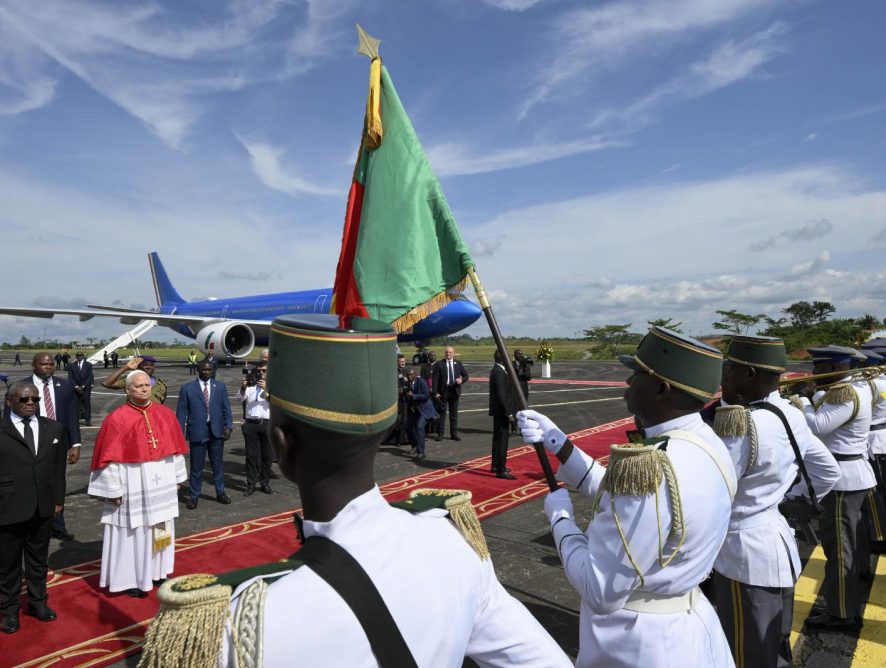
In a nation scarred by a disputed election, state repression, and unresolved civil conflict, a papal visit risked becoming less a mission of peace than a gift of political legitimacy.
Opinion • Africa • Politics & Religion
UZURI MAGAZINE • Opinion & Analysis • Africa • April 2026
Pope Leo XIV came to Cameroon speaking the language of peace. However, in a country reeling from a disputed election, state repression, and a still-burning Anglophone conflict, peace without accountability can look dangerously like endorsement. Therefore, his April 2026 visit, however well-intentioned, was a mistake.
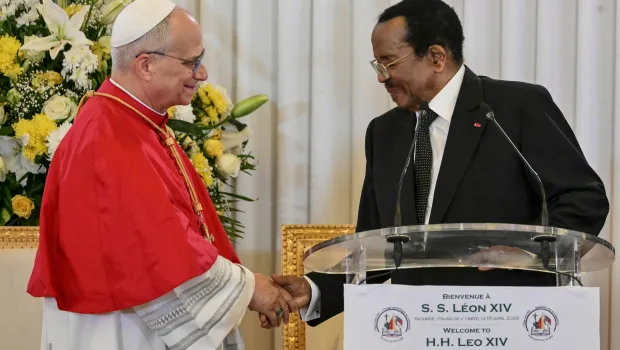
When the pope arrived in Yaoundé — before continuing to Douala and Bamenda — the official language surrounding the visit was predictable: peace, reconciliation, hope, and healing. In a country exhausted by years of political repression, democratic distrust, and bloodshed in its Anglophone regions, these words were designed to sound noble. However, noble language does not automatically produce moral clarity.
The harder question is the one too many diplomats, clerics, and heads of state prefer to avoid: Should the pope have gone at all?
The answer, uncomfortable as it may be for many Catholics and admirers of the papacy, is no.
This is not because Cameroon does not matter. It does. This is not because Cameroonians are unworthy of pastoral attention. They are not. Not because faith has no role in public life. It clearly does. The problem lies in the timing, symbolism, and political reality.
Pope Leo XIV’s visit took place in the shadow of Cameroon’s disputed 2025 election, after authorities were accused of using lethal force and carrying out mass arrests against protesters and opposition supporters. Human Rights Watch reported that security forces responded to post-election protests with killings and mass detention. Rights groups continued to document repression and abuses tied to the state and the long-running Anglophone conflict — a war that has now killed more than 6,000 people and driven over 600,000 from their homes.
| 6,000+ Deaths in the Anglophone conflict | 600,000+ People displaced since the conflict began | 40+ years Paul Biya’s rule in Cameroon |
In this environment, a papal visit could never be interpreted as neutral.
That is the fiction powerful institutions like to maintain: that a visit by the leader of the Catholic Church is purely spiritual, somehow floating above politics and political agendas. However, in a state as tightly controlled and image-conscious as Cameroon, this is nonsense. Optics is a political currency. Ceremonies are political currency. Proximity is a political currency. When a pope appears alongside state officials, delivers addresses to the political class, and participates in nationally staged events, the regime sees a pastoral mission rather than a political one. It sees validation.
In a state as tightly controlled as Cameroon, a visit by the world’s most powerful moral figure is not pastoral. It is a political currency.
This validation is important. President Paul Biya, who returned to office in a contest widely criticized for its lack of credibility, has governed Cameroon for over four decades. His government has faced sustained accusations of not only shrinking the democratic space but also failing to provide any meaningful political solution to the Anglophone crisis. Even as Pope Leo XIV publicly called for justice, transparency, and an end to corruption during the trip, the structural reality remained untouched: the same state accused of repression gained prestige by hosting one of the world’s most powerful moral figures.
This is the central contradiction of the visit. The Pope may have intended to speak the truth to power. However, authoritarian and semi-authoritarian systems are experts at absorbing criticism while still benefiting from the spectacle. A carefully worded rebuke is still a usable photo opportunity. A call for peace is still state-sanctioned theatre if nothing changes after the cameras have left.
The Anglophone conflict is neither a mere symbolic wound nor a simple talking point for the opposition. It represents a severe and ongoing political crisis that has ensnared civilians between armed separatist factions and government forces for an extended period of time. Human Rights Watch and Amnesty International have documented killings, abductions, school attacks, sexual violence, property destruction, and abuse committed by multiple actors. The result has been mass displacement, deep trauma, and the normalization of a conflict that the world too often forgets between headlines.
So, what did the papal visit materially solve?
Not the conflict. Not the legitimacy crisis. Not impunity. Not the underlying political exclusion that fuels the war. Separatist groups announced a brief pause in fighting during the pope’s presence. Many ordinary citizens welcomed the visit sincerely, emotionally, even desperately. Although some hoped for dialogue, a short ceasefire does not equal peace. Large gatherings are not necessarily just, and even sacred hope is not a substitute for policy.
A three-day ceasefire is not peace. A large gathering is not justice. Hope, although important, is not a policy.
This is why critics were right to be skeptical. In situations like Cameroon’s, symbolic interventions often relieve international pressure without changing the balance of accountability. The regime presents itself as stable, respected, and spiritually endorsed. The Vatican presents itself as engaged. The headlines celebrate this unity. Meanwhile, the structural violence remains intact.
A visit of this magnitude should have been conditioned on something more concrete: credible commitments to political dialogue, the release of political detainees, a transparent human rights process, or a genuine framework for addressing the Anglophone crisis in Cameroon. Without that, the visit risked asking Cameroonians to be moved by moral language while their political reality remained fundamentally the same.
This is not a reconciliation. It is pageantry.
There is also a deeper moral issue. Religious leaders often insist that they must go where suffering is greatest. Fair enough. However, there is a difference between accompanying suffering and being used by those who help produce it. In deeply polarized states, neutrality can become complicity when power is ignored. A church that wants to stand with victims must be careful not to stage its compassion in ways that strengthen the hands of oppressors.
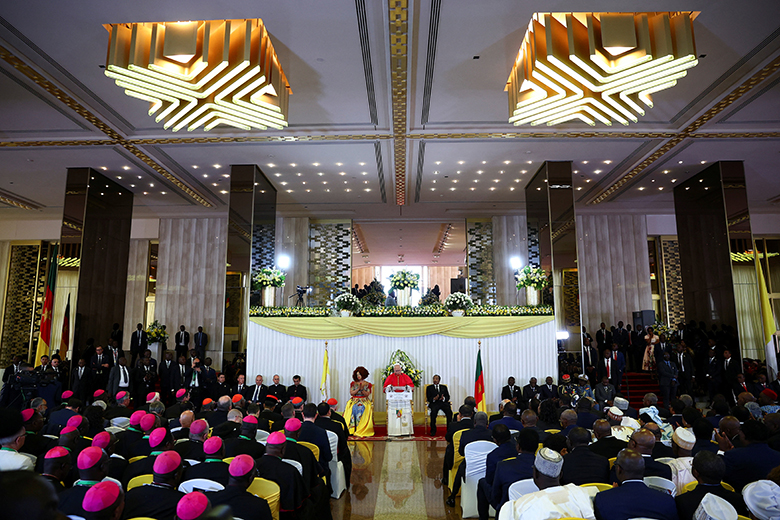
Cameroon did not need a papal spectacle. It needed pressure. It needed honesty. It needed accountability. An intervention was needed that made it harder — not easier — for those in power to continue governing through impunity and manage appearances.
Pope Leo XIV may have come preaching peace. However, in the context of modern Cameroon, peace without political truth risks becoming something entirely different.
That is precisely why he should not have visited.
UZURI Magazine publishes opinions and analyses of African politics, culture, and society. The views expressed in this article are those of the editorial team. The figures cited are drawn from reports by the Human Rights Watch and Amnesty International.
