

A conceptual portrait in which beauty is not worn — it is constructed, layer by deliberate layer.
Some portraits stop you. Not because they are loud, but because they are certain.
This UZURI Studio conceptual image is precisely the type of portrait described above. Everything within the frame has been considered — not merely decorated — and the result is a study of how fashion imagery can move beyond clothing into something closer to visual philosophy.
The headpiece immediately commands the composition. A close-fitted band of rust and black textured weave forms its base, rising from the crown before exploding outward and upward in a wide arc of black feathers. The silhouette it creates is simultaneously ancient and avant-garde — it reads as architecture as much as adornment. Red fringe falls at the periphery, a detail so precise that it functions almost like punctuation: the image’s final, deliberate sentence.
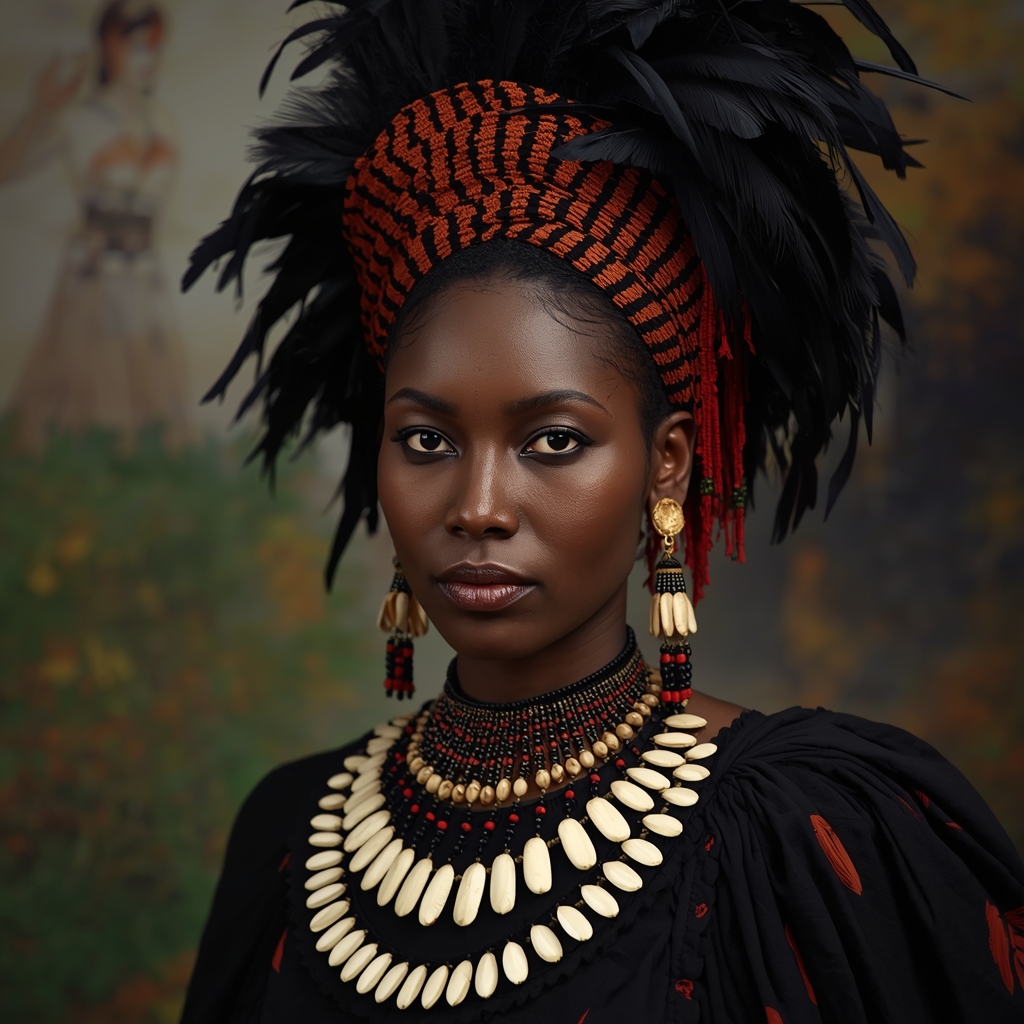
The face at the center of all this drama is a kind of mastery in itself. The skin is flawless, the makeup editorial is not aggressive — a subtle definition at the eyes, a deep neutral on the lips that refuses to compete with the above complexity. The gaze is measured and entirely self-possessed. This is a woman looking at you, but not for your approval.
The jewelry operates in three distinct registers simultaneously. A tight collar of black, red, and gold beads sits high against the throat. Below it, a broader necklace of ivory drops fans across the clavicle with the weight and presence of a breastplate. The earrings — gold coin tops with black-and-ivory tassels — echo both registers, connecting crown to collar in one fluid visual line. Together, the pieces do not merely accessorize the look. They are the look. The dark, draped garment exists to provide them with a stage.
The document prepared for this piece accurately identifies the risk of misrepresenting an image of this nature. Referring to it as “traditional” reduces it to a misleading simplification, while labeling it “exotic” can lead to significant misinterpretation. The appropriate and accurate framing is as follows: a conceptual editorial portrait that explores the grammar of adornment, illustrating how texture, weight, height, and restraint collectively contribute to creating presence.
This is the core proposition of UZURI Studio. African-inspired aesthetics are not a reference library to be raided for atmosphere. They are a living visual intelligence — dynamic, self-aware, and fully capable of generating imagery that stops a scroll, holds a gaze, and lingers long after the page has turned.
The feathers. The beads. The face. The stillness.
This is what it looks like when beauty becomes authoritarian:
